AI Virtual Fitting Rooms
The Future's Shopping Standard
AI is changing everything, ecommerce included. For fashion brands, the improved brand perception, reduced returns, and higher conversions make integration a no-brainer.
Shoppers chase convenience. First it was mail-order catalogs, then digital retail.
Online stores let customers browse with unparalleled ease, but the benefit is not one-sided. The digital transformation gave brands powerful data to better understand shoppers' preferences and market more effectively.
But convenience has a price. Customers delay the most important part of buying clothing, trying it on, until after the purchase. If they do not like what arrives, the customer wastes time returning and re-ordering, and the brand is left paying for the mistake.
Virtual fitting rooms are the next step in that transformation. They give brands new insight into what shoppers actually want while closing the gap between online shopping and brick-and-mortar retail.
What is an AI Virtual Fitting Room?
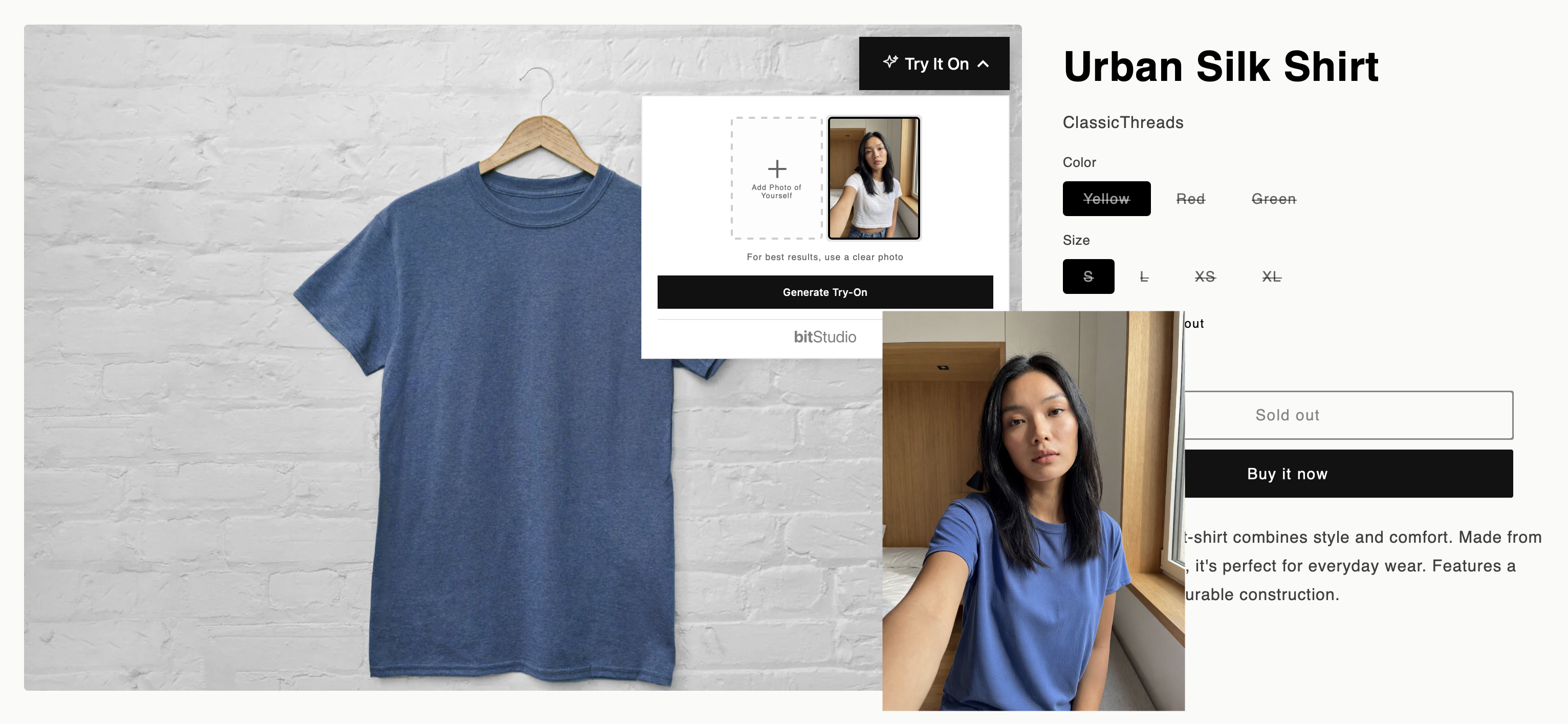
The customer experience is simple. bitStudio's fitting room technology lives directly on any web storefront. No app to download, no camera permissions. Allows shoppers to see how products will look on them before making a purchase. By uploading their own photos, customers can instantly visualize themselves wearing or using the item.
We've made this possible and affordable with tailor-made AI, which seamlessly adds products into customer photos, creating a hyper-realistic preview.
The goal isn't perfection. It's reducing the gap between what a customer imagines and what arrives at the door.
This radically transforms how customers engage with the shopping experience. Instead of just viewing static images of models, customers actively engage with the products. Modern generative AI is leaps and bounds beyond older AR overlays, which produce clunky "paper-doll" style overlays.
bitStudio accounts for fabric behavior - how silk drapes, how denim stretches - and weaves it naturally into the customer's image, no matter their pose or lighting. It's a grounded look at what the product actually looks like.
What It Means for Shoppers
Virtual try-on is no longer a novelty: we see it becoming a baseline expectation for fashion shoppers. Retailers have tried and failed to implement this technology in the last few years.
With the latest technology, it works. But it can only deliver real value if shoppers are willing to use it.
Will they?
Overwhelmingly yes, according to a 2026 study from Vilnius University that surveyed consumers across 23 countries. 84.4% of Gen Z and Millenial respondents had prior experience with augmented reality (AR) tech. 92% of Gen Z said they're interested in AR-based shopping. Both generations are 71% more likely to use it than older demographics.
Strong numbers, but the broader picture matters too.
Zara was the first major brand to roll out virtual fitting rooms at scale. Before that, most try-on tools were relegated to smaller stores or standalone apps and sites that don't benefit the brand.
A major conglomerate like Inditex has the reach, inventory turnover, and sheer volume to actually stress test whether data validates this technology. Early signals suggest it does; shoppers love to play with it.
Simply put, virtual fitting rooms make shopping fun again, and the research backs it up.
When customers enjoy the try-on experience, they perceive it as more useful. When they perceive it as useful, they trust it. And that trust leads to purchases.
The Vilnius University study found that enjoyment was the strongest driver of perceived usefulness in AR shopping. Trust is the second strongest predictor, and you only get trust when the tech works.
The chain is simple.
Fun -> useful -> trusted -> sold.
The market reflects this demand. Virtual fitting rooms are projected to grow from $6.86B in 2025 to $24.30B by 2032, a 3.5x increase in just seven years, according to industry market reports.
What it means for Brands
Returns are the biggest elephant in the room since the COVID-19 driven ecom boom.
These returns aren't a customer service problem. They're inherent to the business model, and one nobody has had a great answer to it. Until now.
Online fashion returns brutalize business margins. Between 30-40% of what ships comes back - double the in-store rate.
Returned items go on a costly tour: return shipping, inspection, restocking, repackaging. And that's if it's going to be resold at all.
The root cause isn't complicated. Fashion is about how it looks. Does this cut sit right on my body? Does this color match my skintone?
Customers try to get around this with "Bracketing", a practice in which they order multiple sizes or colors of an item, with the intent to return all but one. In 2020, a survey from Narvar (a shipping & logistics co that works with over 800 retailers) found that two-thirds of shoppers were bracketing their purchases.
Retailers are resigned to this reality; brands budget for it like rent.
Virtual fitting rooms change the math. Customers can try on items just like they would in a physical store. They can try on every color, right away. A customer whose expectations are aligned with reality is a customer who keeps what they ordered. It doesn't eliminate returns, but it calibrates expectations, helping shoppers make better-informed decisions. Fewer returns drastically reduces brand costs, and nets happier customers to boot.
And that's only half of the story.
Virtual fitting rooms are poised to be the most powerful marketing tool fashion brands have, in two ways.
By adding virtual try-on, every storefront becomes a playground that shoppers want to return to. It inverts typical marketing dynamics; you don't have to convince shoppers to come back. New seasonal collections aren't a request for customers to idly browse, they're an invitation for them to try something on and find something they really love.
Beyond that, virtual fitting rooms strip all the noise out of standard website analytics. You can see exactly which product convinces people to upload their first photo. Which colorways are tried on, and which are actually bought. Over time, customers develop a profile built on deep, meaningful interactions, instead of haphazard clicks while they browse. Data is king, and traditional web marketing campaigns can be personalized to a degree never possible before now.
For Shopify store owners, adopting this technology is a matter of 'when', not 'if'.
The fitting room isn't going anywhere. It's going digital.